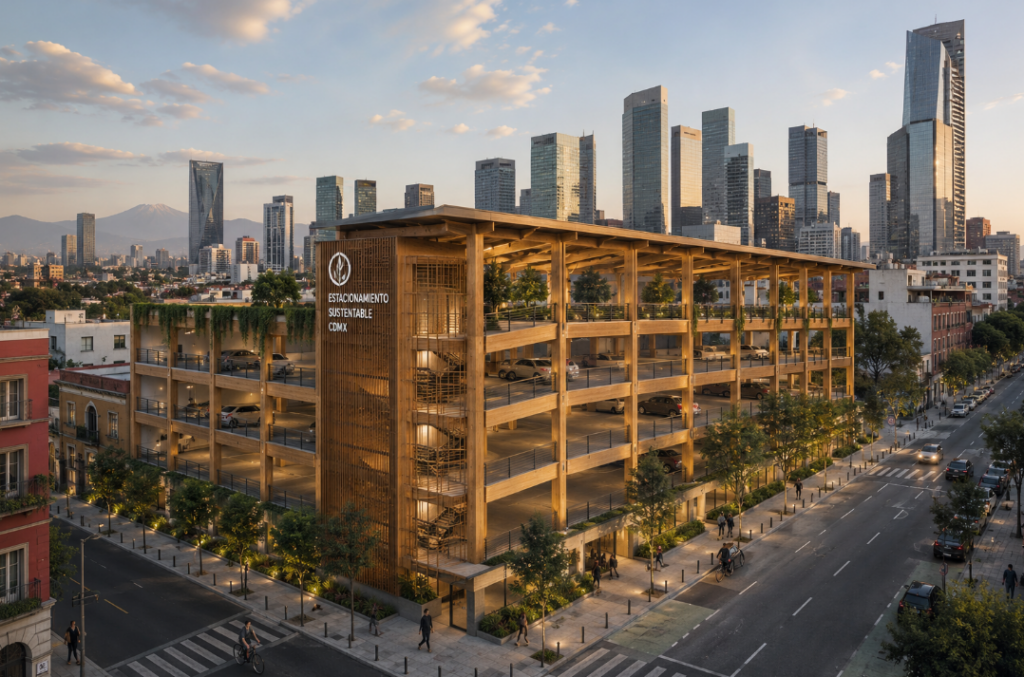
Many great thanks go out to WRNS Studio for publishing this article on Mass Timber Parking. It was a fascinating read!
Here is the article: https://lnkd.in/gbdUcgPd
The WRNS Studio 𝘔𝘢𝘴𝘴 𝘛𝘪𝘮𝘣𝘦𝘳 𝘗𝘢𝘳𝘬𝘪𝘯𝘨 study highlights the significant potential of mass timber as a transformative solution for future parking structure design. Traditionally, parking garages are among the most carbon-intensive building types due to their heavy reliance on concrete and steel. The study demonstrates that integrating mass timber systems, particularly cross-laminated timber (CLT) and glulam, can substantially reduce embodied carbon while improving user experience, adaptability, and overall architectural quality.
The research found that mass timber parking structures are especially well-suited for modular parking layouts because of their repetitive structural grids and open floor plans. By replacing conventional concrete deck systems with timber components, embodied carbon reductions of up to 50% may be achievable, while also lowering overall structural weight, reducing foundation requirements, and improving seismic performance.
A key finding of the study was that hybrid “medium-span” structural configurations provided the best balance between parking efficiency, construction practicality, and carbon reduction. The report also confirmed that large-scale mass timber parking facilities can be designed to meet current building code requirements, including fire resistance, durability, and structural performance standards.
Beyond sustainability, the study emphasizes the enhanced human experience created by exposed timber environments. Compared to traditional concrete garages, timber parking structures offer warmer aesthetics, improved acoustics, increased perceived safety, and a more welcoming atmosphere. These qualities make timber particularly attractive for office campuses, mixed-use developments, airports, universities, and hospitality-oriented projects.
Overall, the WRNS study concludes that hybrid construction approaches, combining timber, steel, and concrete where each material performs best, represent a forward-thinking strategy for creating lower-carbon, adaptable, and human-centered infrastructure.