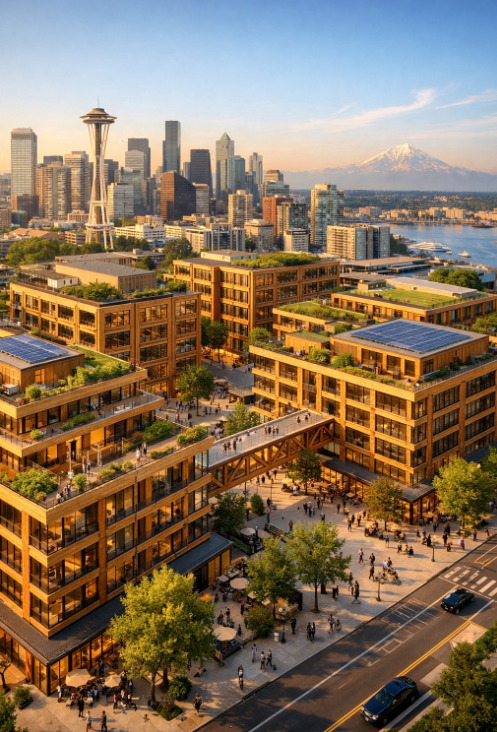
𝐔𝐫𝐛𝐚𝐧-𝐬𝐜𝐚𝐥𝐞 adoption of 𝐦𝐚𝐬𝐬 𝐭𝐢𝐦𝐛𝐞𝐫 shifts construction from individual buildings to fully integrated, district-level development systems. Entire neighborhoods are designed around standardized timber components, coordinated supply chains, and shared sustainability goals.
𝐄𝐜𝐨𝐧𝐨𝐦𝐢𝐜 𝐕𝐢𝐚𝐛𝐢𝐥𝐢𝐭𝐲 𝐚𝐭 𝐒𝐜𝐚𝐥𝐞
• Standardization and repetition reduce costs and construction timelines
• Transitions timber from a niche material to a competitive mainstream solution
𝐒𝐭𝐞𝐩-𝐂𝐡𝐚𝐧𝐠𝐞 𝐢𝐧 𝐂𝐚𝐫𝐛𝐨𝐧 𝐈𝐦𝐩𝐚𝐜𝐭
• District-wide coordination enables measurable, large-scale embodied carbon reduction
• Positions developments as carbon-managed assets, not just buildings
𝐅𝐚𝐬𝐭𝐞𝐫, 𝐌𝐨𝐫𝐞 𝐏𝐫𝐞𝐝𝐢𝐜𝐭𝐚𝐛𝐥𝐞 𝐃𝐞𝐥𝐢𝐯𝐞𝐫𝐲
• Prefabrication + assembly-driven construction accelerates timelines
• Reduces urban disruption and improves project certainty
𝐏𝐥𝐚𝐭𝐟𝐨𝐫𝐦-𝐁𝐚𝐬𝐞𝐝 𝐃𝐞𝐯𝐞𝐥𝐨𝐩𝐦𝐞𝐧𝐭 𝐌𝐨𝐝𝐞𝐥
• Moves real estate toward a systems and manufacturing paradigm
• Buildings become configurable outputs of a repeatable platform
𝐀𝐥𝐢𝐠𝐧𝐦𝐞𝐧𝐭 𝐰𝐢𝐭𝐡 𝐌𝐨𝐝𝐞𝐫𝐧 𝐔𝐫𝐛𝐚𝐧 𝐍𝐞𝐞𝐝𝐬
• Ideal for mid- to high-density, mixed-use environments
• Supports housing delivery, sustainability mandates, and livable urban design
𝐒𝐭𝐫𝐚𝐭𝐞𝐠𝐢𝐜 𝐈𝐦𝐩𝐥𝐢𝐜𝐚𝐭𝐢𝐨𝐧
𝘜𝘳𝘣𝘢𝘯-𝘴𝘤𝘢𝘭𝘦 𝘵𝘪𝘮𝘣𝘦𝘳 𝘳𝘦𝘱𝘳𝘦𝘴𝘦𝘯𝘵𝘴 𝘢 𝘴𝘩𝘪𝘧𝘵 𝘧𝘳𝘰𝘮:
• Project-by-project construction → system-level urban production
• Material choice → integrated climate and development strategy
If proven at scale, this model has the potential to redefine how cities are 𝐟𝐢𝐧𝐚𝐧𝐜𝐞𝐝, 𝐝𝐞𝐬𝐢𝐠𝐧𝐞𝐝, 𝐚𝐧𝐝 𝐛𝐮𝐢𝐥𝐭.
𝐁𝐨𝐭𝐭𝐨𝐦 𝐋𝐢𝐧𝐞
Mass timber districts are not just a sustainability trend – they are an emerging operational model for next-generation urban development, combining industrialized construction, carbon reduction, and scalable economics.